Power Plants: Turbine Halls Reborn
The monumental thermal power station of the mid-20th century was intentionally designed as a civic cathedral of energy. Clad in brick masonry, soaring arched windows, and colossal smokestacks, these structures shielded rotary steam turbines, condenser units, and high-voltage switchgear. Today, their uninterrupted interior spans represent the world's premier venues for monumental contemporary art installations.
Tate Modern: The Bankside Benchmark
Sir Giles Gilbert Scott designed Bankside Power Station on the south bank of the River Thames between 1947 and 1963. After closing in 1981, the brick monolith faced persistent calls for demolition. Instead, Swiss architectural firm Herzog & de Meuron orchestrated its radical conversion for the Tate Gallery, opening in May 2000.
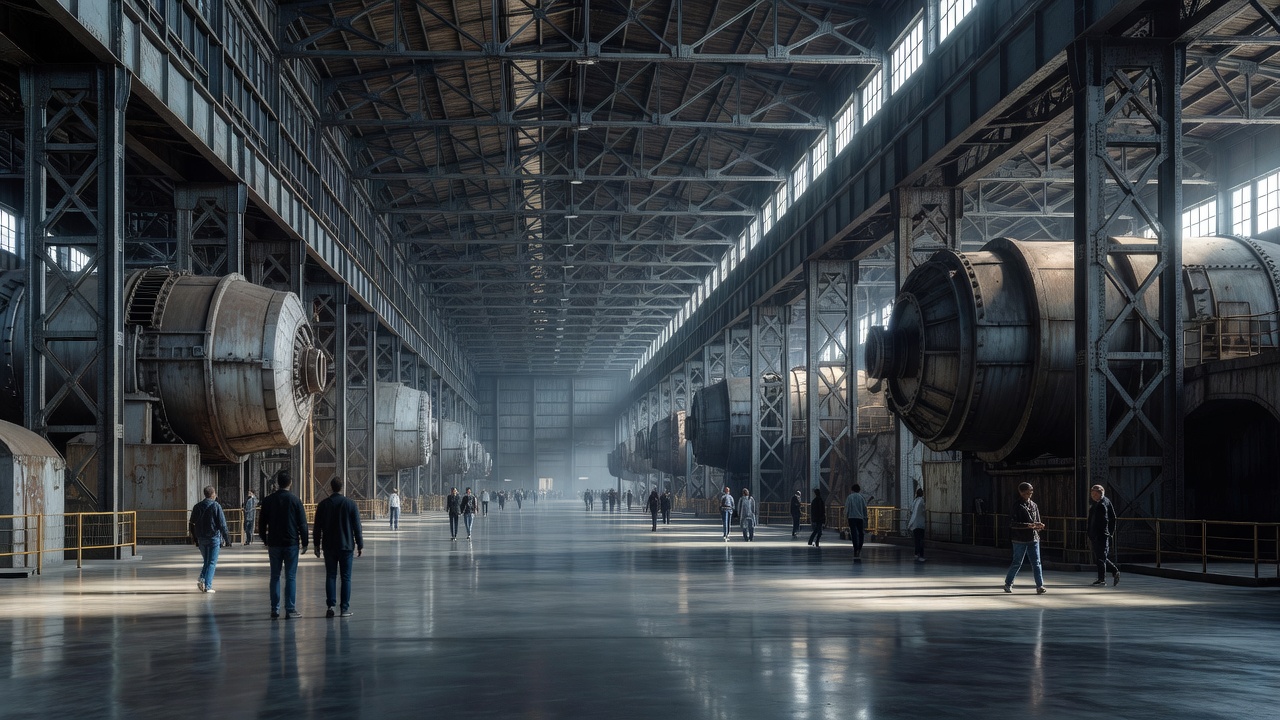
The centerpiece of the transformation is the monumental Turbine Hall: a cavernous space 155 meters long, 23 meters wide, and 35 meters high. Free from internal structural columns, it has hosted legendary spatial installations, including Olafur Eliasson's The Weather Project (a glowing artificial sun), Doris Salcedo’s subterranean floor fissure Shibboleth, and Ai Weiwei’s 100 million hand-crafted porcelain sunflower seeds.
Centrale Montemartini: Ancient Marble Meets Heavy Machinery
In the Ostiense quarter of Rome stands Centrale Montemartini, the city's first public thermo-electric station opened in 1912. When the Capitoline Museums underwent renovations in 1997, conservators temporarily transferred hundreds of classical Roman marble sculptures, sarcophagi, and bust portraits into the power plant's machine hall.
The aesthetic collision was so visually profound that the arrangement was made permanent. Classical white Carrara marble figures representing Aphrodite, Apollo, and Roman emperors stand directly in front of colossal Franco Tosi steam turbines, diesel engine cylinders, and polished brass indicator dials, creating a philosophical dialogue between antiquity and mechanical modernity.
Acoustic and Thermal Engineering of Massive Volumes
Adapting a turbine hall for public cultural access presents extreme environmental physics challenges:
- Acoustic Reverberation: Without heavy dampening materials, bare concrete and steel industrial shells have reverberation times exceeding 8 to 12 seconds, rendering speech unintelligible. Architects install micro-perforated acoustic metal paneling and sound-absorptive baffle baffles.
- Stratified Thermal Heating: In halls with 30-meter ceilings, warmed air naturally rises, causing massive energy inefficiency. Underfloor hydronic radiant heating systems ensure human comfort at the ground pedestrian tier without attempting to heat the cavernous ceiling void.